Dahab: Chapter 4 - The WiFi

If you are a tourist, skip this chapter. Go dive, eat fish, ride a horse. You don’t need the internet. But if you need to work, if you have calls and deadlines and people who expect you to be online at specific times, then I need to tell you that Dahab will probably make you miserable if you don’t read this.
The short version: bring a Starlink Mini.
~~~
The long version: the rest of this chapter.
We tried almost every café. The pattern is always the same. You sit down in the morning, connect to the WiFi, and it works. Fine, even. You think: people on the internet were exaggerating, this is manageable. Then the sun goes down. Around 6 or 7pm the connection starts to stutter. By 8pm it’s either crawling or dead. The reason is simple: every café, every restaurant, every Airbnb in Dahab runs on a mobile internet router. There’s no fibre. There’s no cable. There are roughly three cellular towers serving the entire town, and when everyone gets home from the beach and starts streaming and calling, the towers buckle. It also gets worse when it’s windy, which in January is most of the time.
We developed a tic early on. Before sitting down anywhere, before ordering, before even looking at the menu, one of us would pull out a phone and type “speed test.” It became the first thing we did in any new place. Not “hi, can we see the menu.” Speed test. 6.3 Mbps down. We’d look at each other, shrug, sit down. You take what you can get.
So the cafés are out. Your Airbnb is the same story, because your Airbnb’s router is also on a cellular connection. Same towers.
We tried three SIM cards. The first two were bad enough that I don’t remember their names. Vodafone was the clear winner. They claim it’s 5G. They claim there is 5G coverage in Dahab. There is not. But it works reasonably well during the day, when most people are out doing things instead of loading YouTube. A package costs roughly $30-50 for 40-50GB, which sounds generous until you realise that a few video calls can eat 10GB easily. And in the evening, when the towers get busy, Vodafone slows down too. Less than the others. But enough that having calls becomes impossible.
Our strategy became this: work from the Airbnb in the morning on a Vodafone hotspot, when the connection was decent. Then, for any important evening calls, go to the cowork.
The cowork. I have things to say about the cowork…
There is one coworking space in Dahab. One. It’s near Blue Beach Hotel. It costs $10 per day per person, which in a town where you can eat a full meal for $3 is obscene. For two people, a month of coworking costs more than our apartment. I want to say that for this price you get a professional environment, decent internet, and the basic infrastructure that every $5/day cowork in Bali or Tbilisi manages to provide. You do not.
What you get: several WiFi networks, all on cellular connections, all subject to the same tower limitations as everywhere else. When one slows down you switch to another. When that one slows down you switch again. Some evenings you cycle through all of them and none work. You sit there typing “speed test” after every network switch, watching the numbers drop. 1.2 Mbps. 0.8 Mbps. 0.3 Mbps. Switch again. 1.1 Mbps. You are now an adult person whose primary activity is watching a circle spin on a screen.
You get one call booth. One. For the whole space. Most people don’t bother waiting for it, so they do their calls at their desks, which means the room is a constant low roar of overlapping conversations. The chairs are bad. The lighting in the call booth is bad. The kind of bad where you look slightly grey and ill on camera and your colleague asks if you’re feeling okay.
We had electricity blackouts during calls. The power goes, the WiFi routers go with it, and you’re sitting in a dark room reaching for your phone hotspot while a prospective investor is waiting.
And then there were the children. I don’t mean the scooter children from the street. I mean actual young children who would walk into the cowork, approach people at their desks, and try to sell them bracelets or trinkets or whatever they had. Nobody stopped them. Nobody seemed to think this was unusual. You’re in the middle of a Zoom call, sharing your screen, discussing quarterly numbers, and a seven-year-old appears at your elbow holding up a beaded necklace. I didn’t know what to do the first time it happened. By the third time I had a routine, which was to smile, shake my head, and then spend the next thirty seconds wondering what the hell I was doing in this shithole.
The worst cowork I’ve ever been to. And I’ve been to a lot of coworks in a lot of countries.
If the internet in Dahab were fixed, we would have stayed much longer. Weeks, maybe months, visa permitting. The cost of living is absurd, the diving is world-class, the food is cheap and good, the pace is right. Everything works except the one thing that a remote worker actually needs. And there’s no sign anyone is fixing it, because the tourists don’t care and the hippies don’t have calls.
Buy a Starlink Mini. I didn’t bring one and I regret it in a specific, physical way, the same way I’d regret not bringing a jacket to a place where it turned out to be cold (which I also didn’t do).
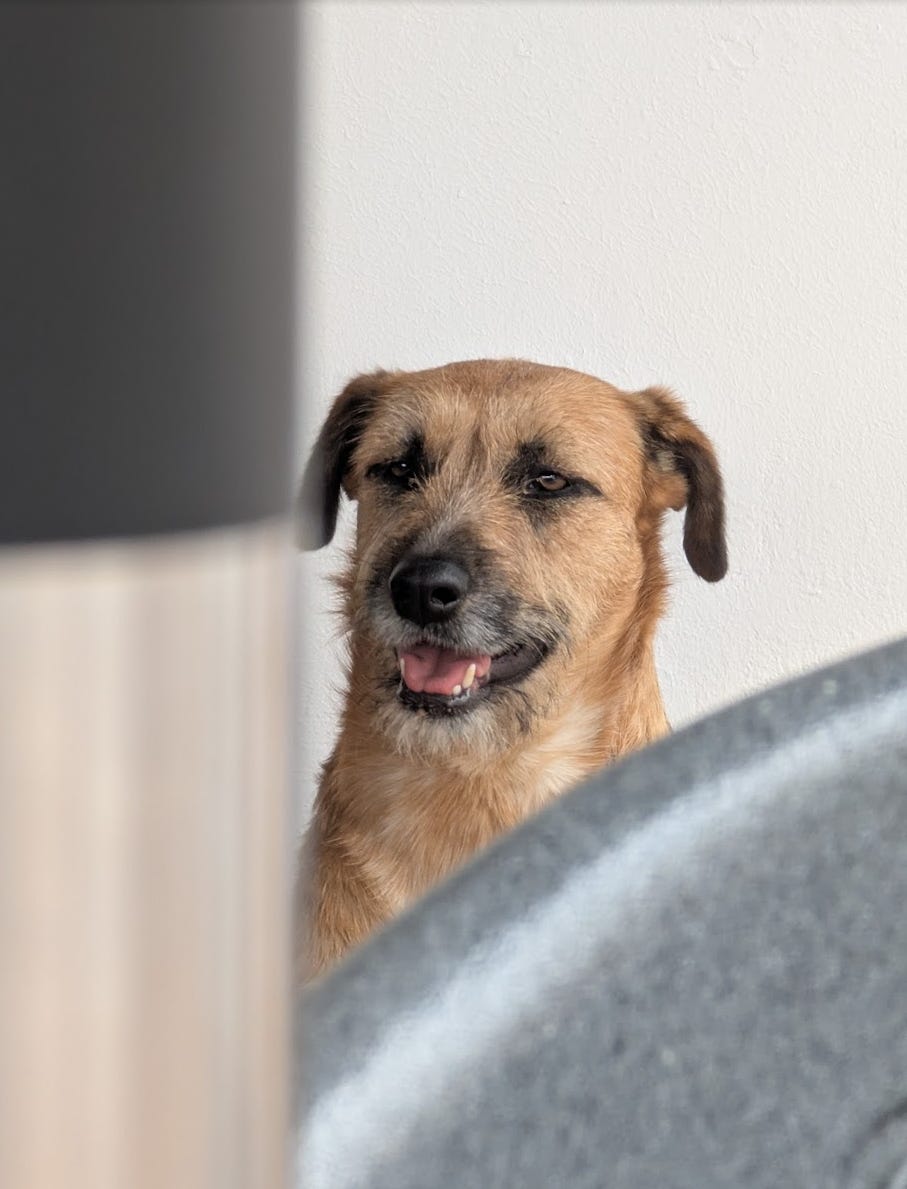
Forsha used to wait outside the cowork on the evenings I was there late. I’d come out at 10 or 11pm, drained from fighting the WiFi, irritated at the call that ran over, and she’d be lying on the warm pavement by the door, half asleep. She had been there the whole time. She didn’t know what WiFi was, she didn’t know what fundraising in a bear market was. She had spent the last three hours in the sea breeze doing absolutely nothing. In a weird way, maybe I did as much.
I’d scratch her ears, we’d go grab a mango juice and we’d walk home and the stars would be out, because there’s very little light pollution in Dahab, and for about ten minutes the internet would seem like someone else’s problem.
Then I’d pull out my phone, out of habit, and type “speed test.”
3.1 Mbps. Not bad for 11pm.