

At EthCC, I saw this gimmick:
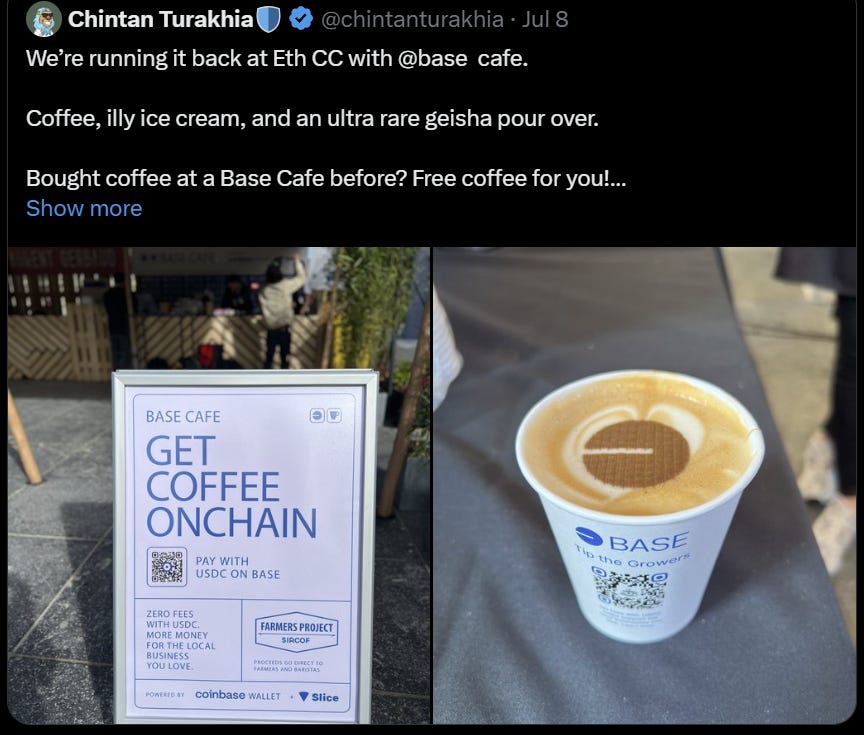
It’s a gimmick because obviously tapping your phone is much easier than to
scan a QR code
go to website
choose product
get USDC and Eth on Base (many, many steps, often involving your banking card, at which point you might have used it from the get-go)
Sign the transaction
Wait for basescan or whatever they use
More importantly, an onchain and banking card transactions are apples and oranges. The correct comparison would be cash vs crypto. I’ve talked about this at Devcon. When I tap a card, there are many things that happen and there is a much richer bundle of services to make it happen:
I tap my card
Merchant device sends the payment request data to payment processor (e.g. Square, Stripe)
Payment processor relays this to card network (e.g. MasterCard, Visa)
Card network checks with issuing bank (the bank that issued the card)
Auth (is it you?)
Sufficient funds?
Issuer sends back either decline or accept
Payment processor relays this
Merchant gets confirmation.
But wait, the transaction is not settled yet. The merchant only got a confirmation that they will get the funds. For a debit card, the issuing bank will already lock these funds to prevent double spending.
The settlement only happens like this:
Batching Transactions: Throughout the day, the merchant's payment processor groups approved transactions into a "batch." This batching often happens at the end of the business day.
Submitting to Card Network: The payment processor sends the batch of transactions to the card networks (e.g., Visa, MasterCard) for settlement.
Card Network Involvement: The card network routes each transaction to the respective issuing bank.
Funds Transfer:
The issuing bank debits the cardholder’s account (or charges it to their credit limit).
The issuing bank transfers the funds (minus interchange fees) to the card network.
Payment to Processor: The card network sends the funds (again, minus their own fees) to the payment processor.
Depositing to Merchant: The payment processor deposits the remaining funds into the merchant’s bank account, usually within 1–3 business days.
There are many faster settlement systems that allow much faster settling times. However, these usually come at extra cost and rely on losing efficiency by not batching or by someone fronting the funds, and thereby taking on some risk.
So how is the fee split? Let’s assume a $100 payment for two bagels and a matcha latte.
The overall fee is 3% which is $3, and it’s composed like this:
interchange fee usually $1-3 (in the EU it’s capped at 0.25%, so $0.25). This is the relevant part as it goes to the card issuer, i.e. the bank.
Services are a small part of this ($0.1-0.4) This includes services such as: fraud prevention, compliance (AML), and processing the transaction itself.
The large part of this is rewards such as points, cashbacks etc. This accounts for $1-2.5.
Assessment fee: $0.1-0.2. This is the fee that actually goes to Visa, MasterCard, Discover etc.
Payment Processor (aka Acquirer): $0.1-1. This goes to Stripe, Square or more traditional points of sale terminal providers. This is for routing the transaction (again).
My guess is that crypto today cannot really solve the largest chunk here: the interchange fee. The interchange fee is the vast majority of the overall fee. And of that, again, it is rewards.
Crypto is very good at settlement, authorisation and self-contained logic (routing, checking balances etc). It is not so good at anything that connects the blockchain to the outside, offchain, world. Services rendered by the issuing bank, such as fraud prevention, dispute resolution, compliance all fall into the latter category. Even rewards are largely connected to the offchain world. After all, cryptonative rewards programmes are famously hard to protect against sybils, a problem with a scale that is unique to crypto.
To summarise, fees such as assessment fees, payment processing can be easily challenged by crypto. However:
this is an efficiency gain of 0.1-1%, not 3-5% often thoughtlessly thrown around.
this assumes that payment processing and assessment can be unbundled from the other services that the bank renders (such as rewards or dispute resolution).
I am confident that there is a subset of transactions where these can be unbundled. More on this another time.